


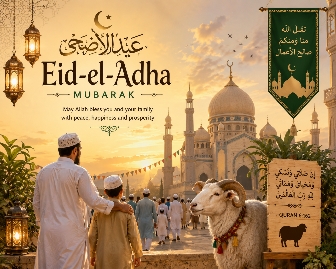
As the world turns attention to Eid al-Aḍḥā so shall our attention turn to in this write up,today being the first Friday in Dhul Hijjah.
Abstract
Eid al-Aḍḥā, the “Festival of Sacrifice,” is the second major festival in Islam and the culmination of the Ḥajj rites. Its observance is rooted in the Qur’anic narrative of Prophet Ibrāhīm’s willingness to sacrifice his son Ismāʿīl, an event commemorated through the ritual of uḍḥiyyah and the communal prayer of ʿĪd. This essay examines the historical origins of Eid al-Aḍḥā in revelation and Prophetic practice, analyzes its theological and legal essence as a manifestation of tawḥīd and submission, and extracts its ethical and social lessons for contemporary Muslim life. The study demonstrates that Eid al-Aḍḥā functions as both a ritual reenactment of prophetic obedience and a framework for moral, social, and spiritual renewal.
1. Introduction
Islamic festivals are not arbitrary celebrations but are legislated acts of worship that encode theological doctrines and social values. Eid al-Fiṭr marks the completion of Ramaḍān, while Eid al-Aḍḥā commemorates the completion of the Abrahamic rites of Ḥajj and the act of sacrifice. Occurring on the 10th of Dhū al-Ḥijjah, Eid al-Aḍḥā is inseparable from the first ten days of Dhū al-Ḥijjah, which the Prophet ﷺ described as the most virtuous days for righteous deeds.
This essay proceeds in three parts. First, it traces the origins of Eid al-Aḍḥā in the Qur’anic narrative and Prophetic Sunnah. Second, it analyzes the essence of the festival as expressed in its legal rulings and theological meaning. Third, it extracts enduring lessons for individual and communal life in the modern context.
2. Origins of Eid al-Aḍḥā
2.1. The Qur’anic Narrative of Ibrāhīm and Ismāʿīl
The origin of Eid al-Aḍḥā lies in Sūrah al-Ṣāffāt 37:102-107. After years of longing for offspring, Ibrāhīm is granted a son, Ismāʿīl. In a dream, Ibrāhīm sees himself slaughtering his son. Recognizing this as a divine command, he presents it to Ismāʿīl, who responds: “O my father, do as you are commanded. You will find me, if Allah wills, of the steadfast” [Qur’an 37:102]. When both submit and Ibrāhīm lays his son for slaughter, Allah calls out: “O Ibrāhīm, you have fulfilled the vision. Indeed, We thus reward the doers of good” [Qur’an 37:104-105]. A ram is substituted as a ransom, and the act is established as a perpetual remembrance.
Classical exegetes emphasize that the test was not about the killing of Ismāʿīl but about the complete submission of will to Allah. Ibn Kathīr notes that the story demonstrates the highest level of tawḥīd: preferring Allah’s command over paternal love and human attachment (Ibn Kathīr, 1999, vol. 7, p. 23).
2.2. Legislation in the Sunnah
The ritual of uḍḥiyyah was instituted in Madinah in 2 AH. Anas ibn Mālik reports that the Prophet ﷺ sacrificed two horned rams, mentioning Allah’s name and performing takbīr (al-Bukhārī, 1997, Ḥadīth 5565). The Prophet ﷺ also linked the sacrifice to the day of nahr, saying: “The first thing we begin with on this day of ours is that we pray, then we return and slaughter” (al-Bukhārī, Ḥadīth 5545). Thus, Eid al-Aḍḥā was established as a day of prayer, sacrifice, and communal gathering.
The festival’s connection to Ḥajj is intrinsic. Pilgrims perform the sacrifice in Minā, while non-pilgrims perform it in their localities, unifying the ummah in one act of remembrance.
3. The Essence of Eid al-Aḍḥā
3.1. Theological Essence: Tawḥīd and Taslīm
At its core, Eid al-Aḍḥā is a ritual expression of tawḥīd al-ulūhiyyah—worship directed solely to Allah—and taslīm, unconditional submission. The sacrifice is not for the sake of blood or meat; Allah states: “Neither their meat nor blood reaches Allah, but what reaches Him is taqwā from you” [Qur’an 22:37]. The act symbolizes the slaughter of the nafs’s desires before the command of Allah. Al-Ghazālī describes it as the outward sign of inward slaughtering of heedlessness and attachment to the dunyā (al-Ghazālī, 1993, vol. 2, p. 213).
3.2. Legal Essence: Uḍḥiyyah as Ritual
Juristically, uḍḥiyyah is a confirmed Sunnah mu’akkadah for the able Muslim, according to the majority of scholars. The animal must meet specific criteria: sound, of age, and slaughtered after the ʿĪd prayer. The meat is divided into three parts: for the family, for relatives and friends, and for the poor. This distribution embeds social solidarity into the ritual. Ibn Qudāmah argues that the purpose is both worship and public benefit, making it a social act of worship (Ibn Qudāmah, 1997, vol. 9, p. 449).
3.3. Temporal Essence: Culmination of Dhū al-Ḥijjah
Eid al-Aḍḥā occurs at the climax of the ten days of Dhū al-Ḥijjah, after ʿArafah and the standing of pilgrims. This timing links individual devotion to communal ritual and historical memory. The takbīr of tashrīq, recited from the 9th to the 13th of Dhū al-Ḥijjah, prolongs the atmosphere of glorification and remembrance.
4. Lessons of Eid al-Aḍḥā
4.1. Submission over Desire
The story of Ibrāhīm teaches that true faith is demonstrated when divine command conflicts with personal desire. In contemporary terms, this applies to economic ethics, family relations, and personal conduct. Muslims are called to prioritize Allah’s law over profit, convenience, or social pressure.
4.2. Trust in Divine Wisdom
Ibrāhīm and Ismāʿīl submitted without knowing the outcome. The lesson is tawakkul: trust that Allah’s command, even when difficult, contains wisdom and mercy. This counters modern attitudes that demand immediate utility or rationalization for every religious act.
4.3. Social Responsibility and Equity
The division of sacrificial meat institutionalizes care for the poor and strengthens communal bonds. In societies marked by inequality, Eid al-Aḍḥā functions as a periodic redistribution mechanism and a reminder that wealth is a trust. Contemporary scholars argue that the spirit of uḍḥiyyah can be extended to organized charitable giving and food security programs (Qaradāwī, 1999, p. 712).
4.4. Unity of the Ummah
Eid al-Aḍḥā is observed globally on the same day, connecting pilgrims in Makkah with Muslims worldwide. This temporal unity reinforces the theological unity of the ummah. The common recitation of takbīr and the shared ritual of sacrifice create a sense of belonging that transcends nationality and ethnicity.
4.5. Ethical Treatment of Animals
Islamic law mandates that the animal be treated well before slaughter, sharpening the knife to minimize pain, and avoiding slaughter in view of other animals. Thus, Eid al-Aḍḥā balances the permissibility of animal sacrifice with ethical constraints, reflecting Islam’s middle position between utilitarianism and absolute animal rights.
5. Conclusion
Eid al-Aḍḥā originates in the supreme test of Prophet Ibrāhīm and is legislated in the Sunnah as a perpetual commemoration. Its essence lies in the outward ritual of sacrifice that signifies the inward submission of the heart to Allah. The festival teaches submission over desire, trust in divine wisdom, social responsibility, and the unity of the Muslim community.
In an age of materialism and individualism, Eid al-Aḍḥā remains a counter-narrative: it calls believers to surrender the most cherished for the sake of Allah, to remember the poor, and to locate personal identity within the historical and spiritual community of Ibrāhīm. The annual reenactment ensures that the legacy of tawḥīd and taslīm is not confined to history but is lived and renewed each year.
References
Al-Bukhārī, M. I. (1997). Ṣaḥīḥ al-Bukhārī (M. M. Khān, Trans.). Riyadh: Darussalam.
Al-Ghazālī, A. Ḥ. (1993). Iḥyāʾ ʿulūm al-dīn (Vol. 2). Beirut: Dār al-Maʿrifah.
Ibn Kathīr, I. (1999). Tafsīr al-Qur’ān al-ʿaẓīm (Vol. 7). Beirut: Dār al-Kutub al-ʿIlmiyyah.
Ibn Qudāmah, M. (1997). Al-Mughnī (Vol. 9). Riyadh: Dār ʿĀlam al-Kutub.
Qaradāwī, Y. (1999). Fiqh al-zakāh (Vol. 2). Beirut: Mu’assasat al-Risālah.
Muslim, M. (1998). Ṣaḥīḥ Muslim (N. al-Khaṭāb, Trans.). Riyadh: Darussalam.
Salihu is DG Media & Publicity for Fityanul Islam of Nigeria
