


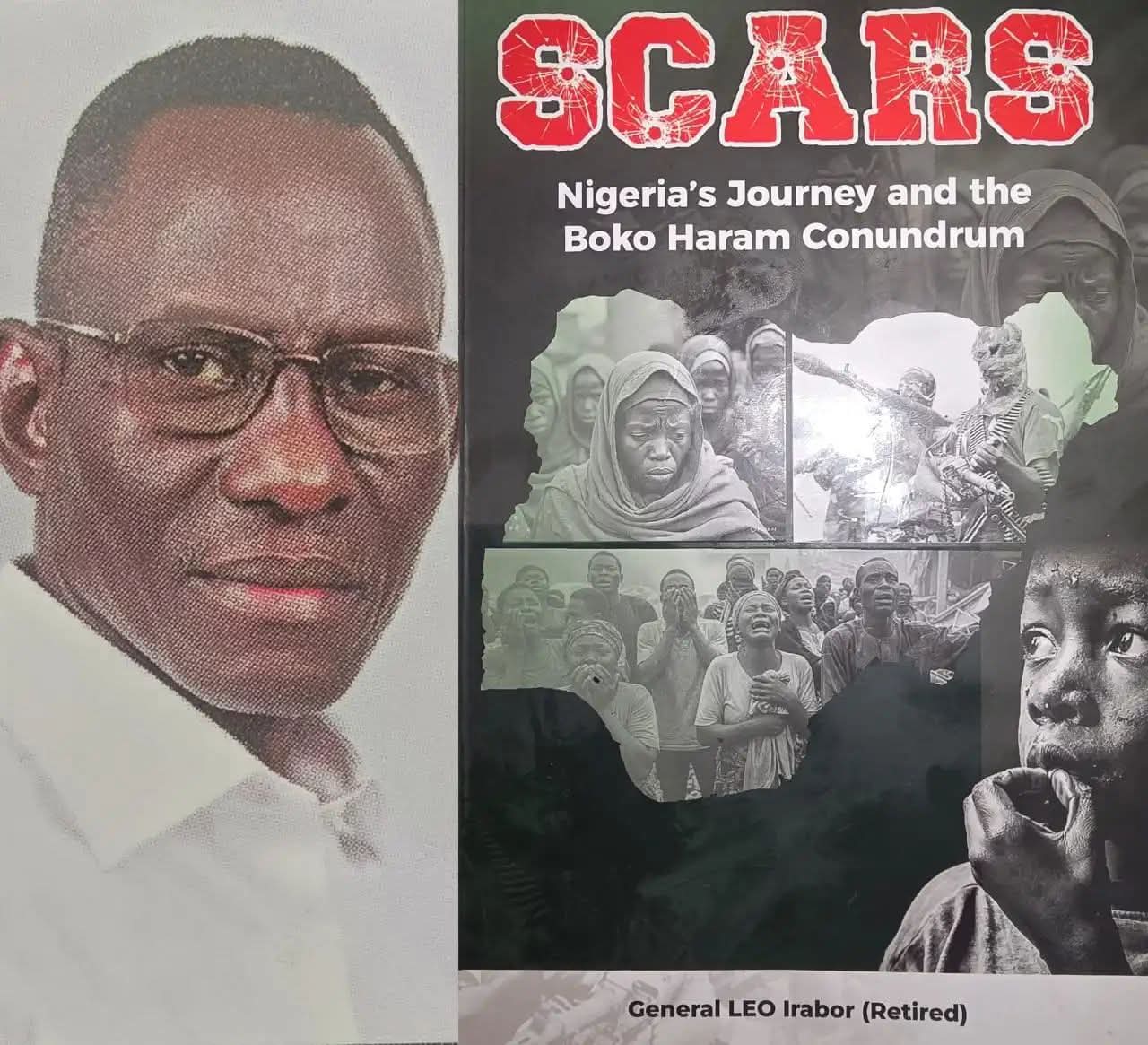
There are few things more dignifying than when a towering public figure extends the courtesy of respect wrapped in humility. General Lucky Irabor, former Chief of Defence Staff, exemplifies that rare blend of strength and grace. When he invited me to the presentation of his new book, “SCARS: Nigeria’s Journey and the Boko Haram Conundrum,” I was reminded that behind the imposing military uniform lies a man of reflection, intellect, and empathy — unless, of course, one dares to cross the line.
This quality stands in sharp contrast to the arrogance I have encountered at a strategic institute where a few officers’ inflated egos left little room for courtesy or intellectual exchange.
I was unable to attend the book launch due to a scheduling conflict with the International Public Relations Association’s (IPRA) Golden World Awards in Ghana, where both the Nigeria Customs Service and my organisation, Image Merchants Promotion Limited (IMPR), were being honoured. On my return to Abuja, all copies of the book had sold out at the designated bookshops, and I was due to travel to Canada that same night. Learning of my predicament, General Irabor personally ensured a copy was sent to me — a gesture that spoke volumes about his character.
Taking the advice of his friend, Vice President Kashim Shettima, that “to truly enjoy a book, read it on a long journey,” I opened it mid-flight and did not stop until I reached the last page. In less than twenty-four hours, I devoured the 300-page memoir — a deeply analytical, well-researched, and intellectually stimulating work that goes far beyond the typical autobiographical recount of a retired general.
Irabor’s SCARS stands out for its narrative style. It is not a self-indulgent memoir but a reflective chronicle that blends personal experience with historical analysis and policy critique. He writes with academic precision, referencing other scholars, field experiences, and verifiable data. Between the lines, the discerning reader can sense his measured but firm convictions on the Boko Haram insurgency, Niger Delta militancy, IPOB separatism, Yoruba nationalism, and the societal decay that has haunted Nigeria since independence.
The book is a panoramic chronicle — from the civil war and military coups to democratic transitions and insurgencies — offering a sober reflection on the choices and failures that have defined Nigeria’s evolution. Notably, Irabor avoids sensationalism or name-dropping; even his acknowledgements are strikingly modest despite the calibre of personalities, including former Presidents, who later attended the unveiling in Abuja.
Former President Olusegun Obasanjo, in his foreword, aptly describes the book as “a soldier’s honest reflection on a nation’s unfinished journey.” But the true revelations lie within the pages — in Irabor’s unflinching interrogation of Nigeria’s political and moral contradictions.
Among the book’s most intriguing points is his assertion that no full-fledged coup d’état in Nigeria has ever occurred without civilian collaboration. He argues that soldiers, bound by their oath of allegiance, often justify interventions “through the prism of national defence.” This interpretation shifts part of the blame for Nigeria’s military incursions to opportunistic civilians who manipulate or enable such actions for personal gain.
Equally provocative is his historical framing of Northern Nigeria’s recurring religious conflicts. Irabor traces their roots to Usman Dan Fodio’s jihad of 1804, viewing it as the starting point of organized religious militancy in the region. While this perspective is historically grounded, it risks oversimplification. Thankfully, Irabor tempers his argument by contextualizing it within the broader “millenarian revolts of early colonialism,” suggesting that both Islamic revivalism and Christian evangelism during the colonial era contributed to shaping Nigeria’s spiritual and social divides.
One area readers may find conspicuously absent is any mention of the tragic death of gallant General Ibrahim Attahiru, the late Chief of Army Staff, who perished in a plane crash shortly after Boko Haram’s leader, Abubakar Shekau, was reportedly killed. Given Irabor’s position as the CDS, his silence on the matter is perhaps deliberate — an act of discretion from a professional soldier who values institutional continuity over personal disclosure.
Still, his candour shines through elsewhere. The sections on Northern Nigeria’s political elite are unambiguously critical. Irabor faults the region’s leaders for presiding over deepening poverty, illiteracy, and insecurity despite their educational exposure and political dominance. He cites World Bank data showing that the ten poorest states in Nigeria are all in the North-East and North-West, with 87% of the nation’s poorest population concentrated there. He attributes this grim reality to elite hypocrisy, religious manipulation, and the failure to translate political power into social progress.
He particularly denounces the politicisation of religion, using the Sharia Movement in Zamfara (1999) as a case study of how political opportunism derailed governance. Quoting Emir Sanusi Lamido Sanusi, Irabor laments the “commodification of piety” — a process through which religion becomes a tool of control rather than a vehicle for moral upliftment.
He calls on Northern leaders to emulate progressive Muslim societies like Saudi Arabia and Turkey, which have harmonised faith with modernity rather than allowing religion to justify stagnation. His position on the Almajiri system is particularly powerful; he argues that no faith sanctions the institutionalisation of street begging or the abandonment of children in the name of learning.
The chapter on the “Dead Horse Theory” is one of the book’s most intellectually stimulating sections. Here, Irabor uses the metaphor to describe Nigeria’s tendency to keep “beating dead horses” — sustaining failed policies and obsolete institutions instead of pursuing meaningful reform. He cites the duplication of examination bodies like WAEC and NECO, the Nomadic Education Programme, and the regional cut-off mark policy as examples of how Nigeria perpetuates inefficiency under the guise of inclusiveness.
The discussion on Boko Haram is both historical and diagnostic. Irabor situates the insurgency within a continuum of religious and socio-political crises, from the Maitatsine riots of the 1980s to the Sharia clashes of 1999–2000. He chronicles how Mohammed Yusuf, the sect’s founder, began as a member of Borno’s Sharia Implementation Committee, only to break away and radicalise disillusioned youth by preaching against Western education and government corruption. The book exposes the irony of Boko Haram’s dependence on Western technology — weapons, communication tools, and propaganda platforms — even while denouncing Western civilisation.
Irabor portrays Boko Haram not as a purely religious movement but as a symptom of governance failure, economic deprivation, and elite negligence. He identifies the drivers of extremism as “unaddressed political grievances, weaponisation of religion and tribe, a biased legal framework, and weakened institutions.”
The author also voices deep concern over what he described as an international conspiracy against Nigeria, singling out certain foreign entities and media organisations. He accuses them of not only supplying logistical support to terrorist groups but also of deliberately spreading false narratives aimed at discrediting the Nigerian military and destabilising national security.
In his closing reflections, the General offers a pragmatic pathway forward: diplomatic negotiation, socioeconomic and political realignment, and governance reforms that reward merit and restore trust. “The time for change is now,” he writes, “and it must begin with truth, inclusion, and a commitment to genuine progress.”
SCARS is not just a memoir; it is a mirror reflecting Nigeria’s wounds — the scars of war, hypocrisy, and wasted potential. Irabor’s writing is measured but fearless, scholarly yet deeply human. His critique of the North is not an attack but a plea for introspection; his assessment of Nigeria’s leadership failures is not cynical but reformist.
This book is an essential read for anyone seeking to understand Nigeria’s enduring crises — from insurgency and leadership to the complex interplay between faith, politics, and national identity.
General Lucky Irabor’s SCARS leaves readers not with despair, but with hope — the hope that confronting our scars honestly is the first step toward national healing.
Yushau A. Shuaib is the author of ‘An Encounter with the Spymaster’ and ‘Award-Winning Crisis Communication Strategies.’ yashuaib@yashuaib.com
