


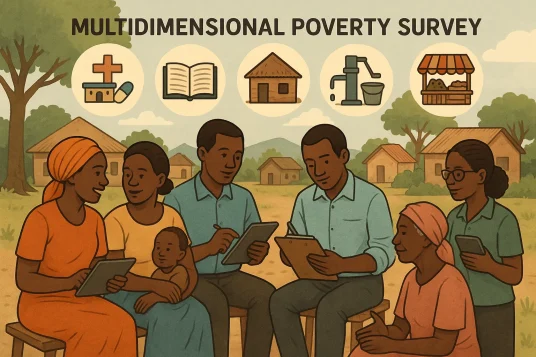
“Circumstances do not make the man; they reveal him.” James Allen’s words resonate deeply within the Nigerian and broader African context, where poverty is often explained almost entirely as a product of failed systems. Weak governance, corruption, colonial legacies, insecurity, poor infrastructure, unemployment, and limited access to capital are frequently cited, and rightly so. These structural realities are not imaginary. They shape opportunities, constrain choices, and create unequal starting points. Yet, even within the same cities, villages, institutions, and households, people facing similar constraints often experience radically different outcomes over time. This reality suggests that beyond systems and policies, poverty in Nigeria and across Africa also has a strong behavioral, cultural, and psychological dimension. It is sustained by patterns of thinking, habits of action, and social norms that quietly compound year after year, becoming normal, familiar, and largely unquestioned.
Education illustrates this tension clearly. In Nigeria, access to education remains uneven, with overcrowded public schools, underfunded universities, frequent strikes, and stark rural–urban disparities. In many communities, children still walk long distances to poorly equipped classrooms, while teachers struggle with low morale and inadequate pay. These systemic challenges are real. However, alongside them exists a growing cultural disengagement from learning itself. Education is increasingly viewed instrumentally, not as a process of intellectual formation, but merely as a certificate required to escape poverty. As Alvin Toffler warned, “The illiterate of the twenty-first century will not be those who cannot read and write, but those who cannot learn, unlearn, and relearn.” In Nigeria, many stop learning the moment formal schooling ends. Reading culture has declined. Skill acquisition outside certificates is often neglected. Curiosity is replaced by credentialism. As the economy evolves and technology reshapes work, this avoidance of continuous learning quietly locks people out of opportunity, even when degrees are present.
The challenge is not only access to education, but the erosion of a learning culture. In many African societies, questioning is discouraged, critical thinking is underdeveloped, and conformity is rewarded over curiosity. Young people are often taught to memorize rather than to think, to obey rather than to explore. Over time, this produces graduates who struggle to adapt, innovate, or compete in a globalized economy. Education expands perspective and economic mobility, but when learning becomes passive and transactional, its transformative power is lost.
Financial behavior reflects a similar contradiction. Nigeria is not a poor country in absolute terms. It is a resource-rich economy with significant flows of income across oil, trade, services, and remittances. Yet financial insecurity is widespread, even among middle-income earners. This is not solely due to inflation or low wages. It is also shaped by spending culture, social pressure, and weak financial discipline. Emotional spending, extended family obligations, social ceremonies, and the pressure to display success drive consumption patterns that undermine saving and investment. As Warren Buffett advised, discipline matters more than income. In many Nigerian contexts, the pressure to “show evidence” of success leads people to prioritize appearances over foundations, consumption over capital, and today’s validation over tomorrow’s security.
Fear of risk further compounds stagnation. Nigeria’s business environment is genuinely hostile in many respects. Poor infrastructure, inconsistent policies, unreliable power supply, insecurity, and weak access to finance make entrepreneurship difficult. These realities understandably heighten risk aversion. Yet fear often extends beyond rational caution into psychological paralysis. Many remain trapped in underemployment or unproductive routines because the uncertainty of change feels overwhelming. Peter Drucker’s warning about acting with yesterday’s logic is particularly relevant here. When people avoid skill transitions, technology adoption, or new economic models because of fear, they gradually become irrelevant in a fast-changing economy.
Blame culture also plays a significant role. In Nigeria, it is easy to blame the government, and often justifiably so. However, when blame becomes totalizing, it strips individuals of agency. Viktor Frankl’s insight that we must change ourselves when situations cannot be changed speaks directly to this context. Constant blame fosters helplessness, resentment, and political cynicism, but rarely produces personal transformation. Accountability does not deny structural injustice. It simply recognizes that progress often begins with how individuals respond to imperfect systems rather than waiting indefinitely for those systems to improve.
Negativity thrives in environments of prolonged hardship, and Nigeria has no shortage of such pressures. Economic instability, insecurity, unemployment, and inflation create a collective sense of fatigue and pessimism. Social discourse becomes saturated with despair. Henry Ford’s observation about mindset becomes painfully relevant. When negativity dominates public and private conversations, it shapes expectations. Young people begin to believe effort is futile unless one has connections, shortcuts, or luck. This mindset quietly erodes resilience and persistence, reinforcing the very outcomes it fears.
The absence of clear goals worsens this drift. Many young Nigerians are busy, hustling across multiple activities, yet lack long-term direction. Survival replaces strategy. Antoine de Saint-Exupéry’s reminder that a goal without a plan is merely a wish captures this reality. Without structured goals, energy is scattered across short-term pursuits that offer immediate cash but little growth. Years pass, not because effort was absent, but because direction was missing.
Procrastination further entrenches stagnation. In an environment where opportunities feel scarce and failure feels costly, delay becomes a coping mechanism. Skills are postponed. Health is ignored. Savings are deferred. Napoleon Hill’s description of procrastination feels almost tailored to this reality. Meanwhile, opportunities created by digital work, remote employment, and global markets pass many by, not due to lack of intelligence, but due to delayed action.
Health outcomes in Nigeria and much of Africa reveal another critical dimension. Poor access to healthcare, inadequate WASH infrastructure, unsafe water, poor sanitation, and weak public health systems impose heavy burdens on productivity. Frequent illness, preventable diseases, and untreated conditions drain households financially and emotionally. A fatigued population cannot sustain economic growth. Health is not merely a social sector issue; it is an economic infrastructure. When people lack access to clean water, sanitation, and basic healthcare, their capacity to learn, work, and innovate is severely constrained.
Bad habits flourish in this context. Irregular sleep, poor nutrition, substance abuse, and unhealthy coping mechanisms become normalized responses to stress. Aristotle’s insight about habits shaping identity is particularly relevant in societies where survival pressures overwhelm long-term planning. Motivation comes and goes, but habits quietly determine outcomes.
Complaining then becomes a dominant social currency. In Nigeria, public discourse is saturated with complaints, from politics to religion to economics. While grievances are often legitimate, constant complaining without action drains collective energy. Theodore Roosevelt’s warning about complaining without proposing solutions rings true. Societies stagnate not only when problems exist, but when problem-solving culture is weak.
The absence of savings deepens vulnerability. Inflation, currency depreciation, and unstable income streams make saving difficult, but the lack of a savings culture worsens the problem. Without buffers, every shock becomes a crisis. Benjamin Franklin’s metaphor of small leaks applies painfully well. Many households collapse financially not because of large disasters, but because of repeated small shocks with no cushion.
Living only for today has become more pronounced in the digital age. Social media amplifies instant gratification, comparison, and the illusion of effortless success. The “soft life” narrative, when detached from productivity and discipline, reinforces the idea that enjoyment should precede effort. Yet, as the saying goes, the future depends on what is done today. When present pleasure consistently overrides future preparation, long-term vulnerability becomes inevitable.
This is where the “quick-rich” syndrome becomes particularly destructive. Across Nigeria and parts of Africa, stories of sudden wealth through fraud, speculation, gambling, or illicit activities dominate public imagination. Social media celebrates wealth without context, success without process, and consumption without explanation. Louis Pasteur’s reminder that chance favors the prepared mind is drowned out by viral narratives that disconnect wealth from work, integrity, and patience. Over time, this erodes values, undermines the dignity of labor, and weakens moral restraint.
Self-discipline becomes a casualty. Jim Rohn’s description of discipline as the bridge between goals and accomplishment highlights what is missing. Without discipline, ambition becomes fantasy. People start strong, abandon quickly, and gradually lose trust in themselves. Discipline is not punishment. It is structured in a chaotic environment.
Many of these behaviors are learned unconsciously. Carl Jung’s warning about the unconscious directing life as fate applies powerfully here. Poverty is transmitted not only through lack of resources but through beliefs, habits, and expectations passed across generations. Children absorb attitudes toward money, work, education, and integrity long before they earn income.
Environment and social networks then reinforce these patterns. In many Nigerian settings, toxic peer pressure normalizes shortcuts, mocks diligence, and ridicules patience. “He who walks with the wise grows wise” is not merely a proverb; it is an economic truth. Environment shapes aspiration, effort, and ethics.
Ultimately, poverty in Nigeria and Africa is not defined solely by income or infrastructure. It is sustained by familiar patterns that feel safe even when they are destructive. John Maynard Keynes noted that the real difficulty lies not in developing new ideas, but in escaping old ones. Structural reform is essential, but behavioral transformation is equally critical. When learning culture is revived, resilience restored, values re-centered, and discipline reclaimed, change becomes possible. Progress may be slow, but it becomes sustainable. God is with us!
